Submission to the Second Action Plan Under the National Plan to End Violence Against Women and Children
FCAN is calling for a new, integrated Family Justice System.
ONE SYSTEM. ONE DOORWAY. ONE STORY.
(July 2026)
THE FAMILY LAW SYSTEM IS HARMING WOMEN AND CHILDREN EXPERIENCING DOMESTIC AND FAMILY VIOLENCE.
Women escape violent and controlling relationships believing that leaving will make them and their children safer.
Instead, survivors report being disbelieved, misidentified and blamed for trying to protect their children.
State systems can identify family violence and put protections in place. Then a matter reaches family law and those protections can be overridden. Children can be ordered into contact they fear. Protective parents become the problem for raising safety concerns.
Sometimes the consequence is devastating. In a practice known as the "cold swap", a child is abruptly removed from the parent who has been their primary caregiver and main attachment figure and placed with the parent they have disclosed against or fear.
FCAN reviewed 20 published final judgments from 2023 to 2025 on the Magellan list, the Court's specialist pathway for the most serious allegations of child abuse.
In those 20 judgments:
80% produced no protective outcome.
75% involved children's disclosures dismissed or minimised.
65% resulted in mothers' time reduced, supervised or suspended.
65% resulted in children living with their fathers.
If Australia's specialist pathway for serious child abuse produces these outcomes, we must stop asking how to reform the existing system and start asking whether it is fit for purpose.
This is not something another training program, protocol or amendment can fix. Australia has spent decades reforming family law. The harm continues.
The National Plan to End Violence Against Women and Children cannot succeed while the family court can undo the protections designed to keep women and children safe.
FCAN is calling for a new, integrated family justice system, consistent with Recommendation 1 of the Australian Law Reform Commission's 2019 Family Law for the Future report.
Family law, child protection and specialist domestic and family violence responses brought together, returned to the state .
Centred on safety and holding the person using violence accountable.
An inquisitorial system that investigates risk and evidence, rather than forcing traumatised families through an adversarial contest.
Properly funded, so safety never depends on who can afford to fight.
A woman should never face an impossible choice: stay with an abuser and risk child protection removing her children, or leave and risk the family law system removing them anyway.
The childhoods of survivor children should never be the price their protective parent pays for escaping violence.
It is time to build the system we actually need.
#OneSafeSystem
FCAN Submission: Australia's Seventh Periodic Report under the ICCPR
(June 2026)
ICCPR stands for the International Covenant on Civil and Political Rights. It's a United Nations human rights treaty that Australia has signed, covering rights like the right to a fair trial, freedom from cruel treatment, privacy, family life, and equality before the law. Countries that sign it have to report periodically to the UN Human Rights Committee on how well they're upholding those rights, which is the report FCAN's submission responds to. FCAN's submission points out a big gap in Australia's latest report.
The report talks a lot about helping women and children who experience domestic violence. But it says almost nothing about what happens to them once they enter the family law system after leaving an abuser.
This matters because the family courts hold enormous power. They decide where children live, whether they keep seeing a parent, and whether claims of abuse are believed.
Drawing on our own research into court judgments and on Australian and international studies, FCAN's submission shows what too often happens next. In our analysis of 20 recent judgments involving the most serious abuse allegations:
Fathers were granted sole parental responsibility in around 70 per cent of cases.
Child sexual abuse allegations were not accepted in around 80 per cent of cases.
Children's own disclosures were discounted or explained away in around 75 per cent of cases, often blamed on the mother.
The submission also describes how:
Women are made to prove the same abuse over and over in each system they face.
Court processes are used to drain women financially and force ongoing contact with an abuser.
Children are sometimes removed abruptly from the parent trying to protect them.
FCAN is calling on Australia to be honest with the United Nations, and to:
Report on what actually happens to women and children in family law proceedings.
Address the way court processes can be used to continue abuse.
Set up proper independent oversight of the family law system.
FCAN Submission: Inquiry into the relationship between domestic, family, and sexual violence and suicide
(February 2026)
The Australian Parliament is examining how domestic, family and sexual violence contributes to suicide, and how these deaths are counted. FCAN's submission argues that a whole group of these deaths is being missed.
When a woman or child dies by suicide during or after family court proceedings, that death is rarely counted as connected to family violence, even when the court process itself played a clear part.
FCAN's submission explains how the family law system can drive people to despair, particularly after they have left an abuser and disclosed violence. It describes how:
Victims are often disbelieved, labelled as "high conflict" or "alienating," and treated as the problem rather than the person at risk.
Seeking mental health support during proceedings can be used against a woman in court, forcing her into silence when she most needs help.
Long court battles can strip people of their homes, income and financial security.
Children can be forced into contact with a parent they fear, or removed from the parent protecting them, with some children showing serious distress, self-harm, or suicidal thoughts as a result.
FCAN is calling on the Government to:
Count deaths by suicide linked to family violence and family court processes properly, including the role of the system itself.
Stop family court orders that override domestic violence orders and child protection assessments.
Listen to children's fears and wishes and recognise a child's right to refuse contact that causes them harm.
Implement the reforms that inquiries and Royal Commissions have already recommended and be accountable when they choose not to.
FCAN Submission: Violence Against Mothers as a Distinct and Overlooked Human Rights Violation
(February 2026)
FCAN made this submission to the United Nations Special Rapporteur on Violence Against Women and Girls, for the 62nd session of the UN Human Rights Council. It argues that "violence against mothers" is a distinct form of gender-based violence that is too often overlooked.
The core argument is that a mother's role, especially when she is trying to protect her children, is used as a weapon against her, both by abusers and by the systems that are supposed to help. After separation, abuse often moves out of the home and into the courts and other legal processes, where it can continue in a new form.
FCAN's submission describes how:
Mothers who raise concerns about abuse are frequently disbelieved and recast as vindictive, obstructive or "unstable," so the focus shifts away from the violence.
Discredited concepts like "enmeshment" and parental alienation are used to treat a mother's bond with her child as a problem, and to dismiss children's fear and distress.
Long, expensive court battles push mothers into poverty and housing insecurity, a form of economic abuse the submission calls "court-induced poverty."
Children are abruptly removed from a protective mother or forced into contact they fear, causing lasting psychological and physical harm.
The forcible removal of children by police under Recovery Orders can amount to state violence against mothers and children.
Deaths by suicide linked to these processes are missing from official violence statistics.
FCAN is calling on the Special Rapporteur to recommend that governments:
Recognise violence against mothers as a distinct form of gender-based violence, including where the State itself enables it.
Stop the removal of children from protective mothers and ban punitive supervision orders.
Prevent family courts from overriding state protection orders backed by specialist evidence.
End privately funded supervised contact and properly regulate these services.
Set up independent accountability and rapid safety review for unsafe parenting orders.
Treat post-separation economic abuse, including litigation abuse and court-induced poverty, as violence against mothers.
Invest in long-term recovery support designed for children.
FCAN Universal Periodic Review (UPR) Submission
(October 2025)
The Family Court Accountability Network (FCAN) was formed in 2025 by five survivor-leaders who came together with a single purpose: to ensure Australia could no longer hide the truth of what is happening to women and children inside the Family Court.
Together, we worked around the clock to prepare Australia’s grassroots, survivor-led submission to the United Nations for the 4th Cycle Universal Periodic Review, documenting systemic human-rights breaches, unsafe orders, gender bias, economic abuse, and court-enabled violence.
Although we missed the official UN deadline by only a few weeks, the work was so substantial, so evidence-heavy and so urgent, that it has now been logged as a formal human rights complaint.
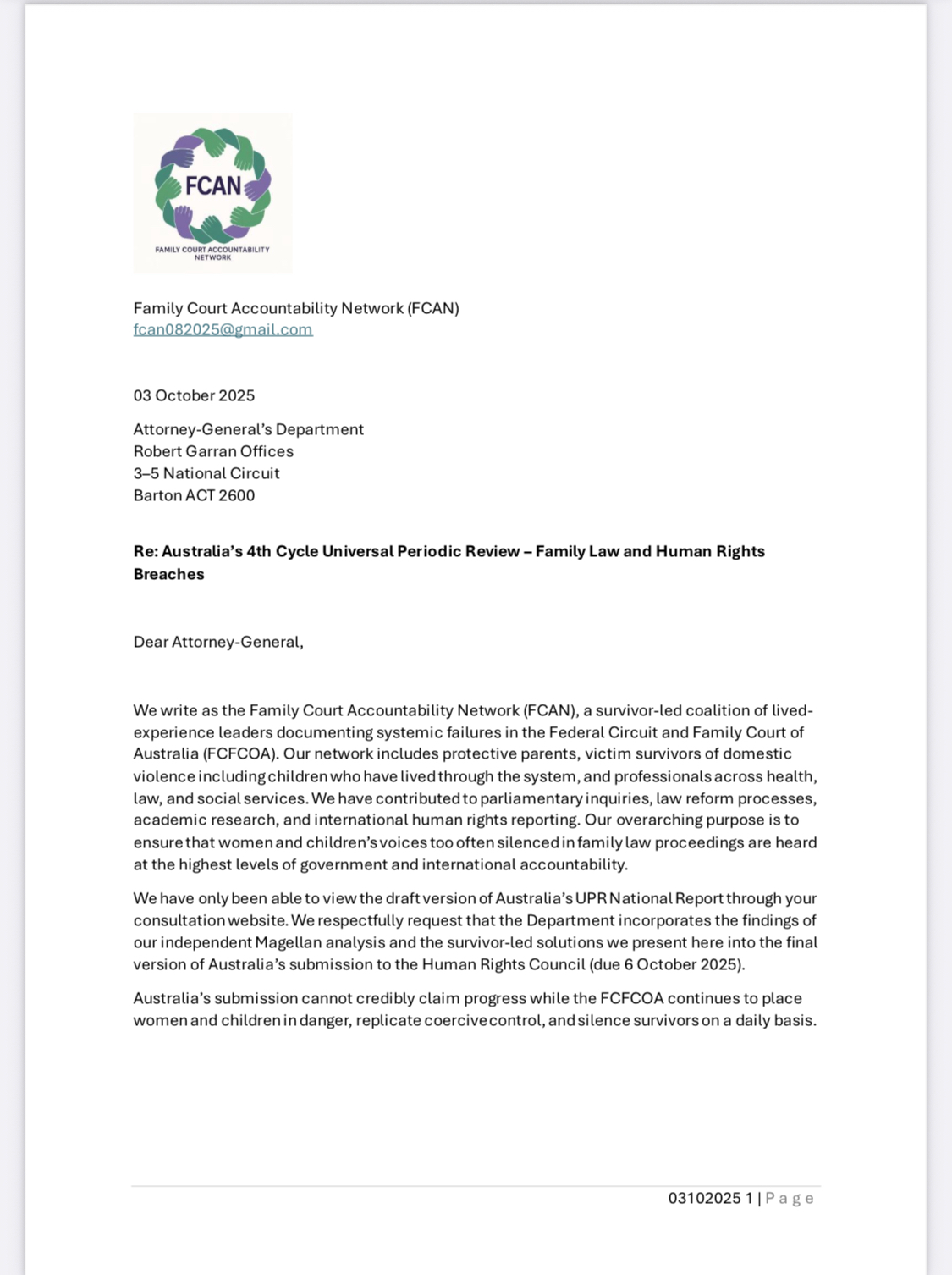
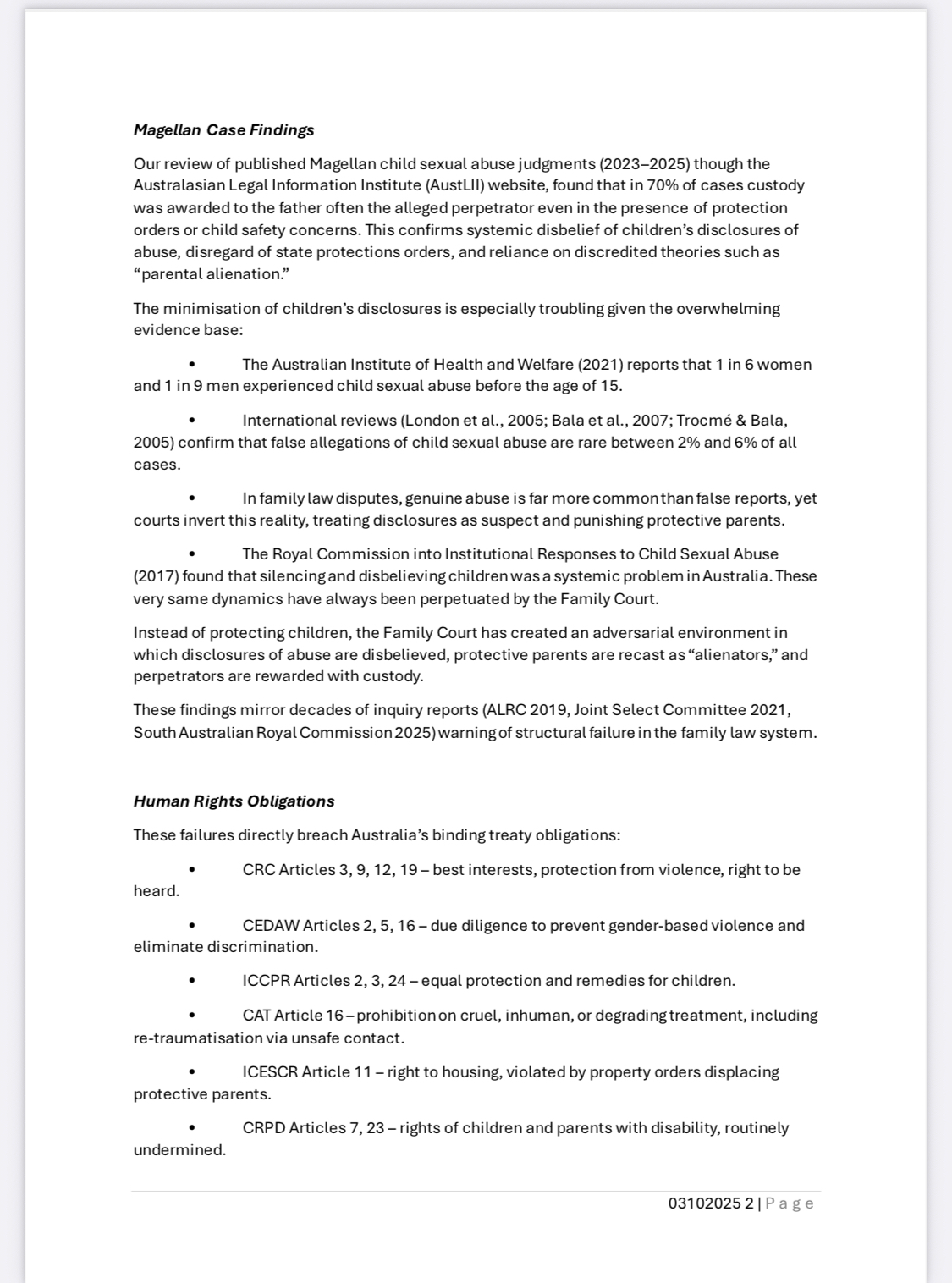
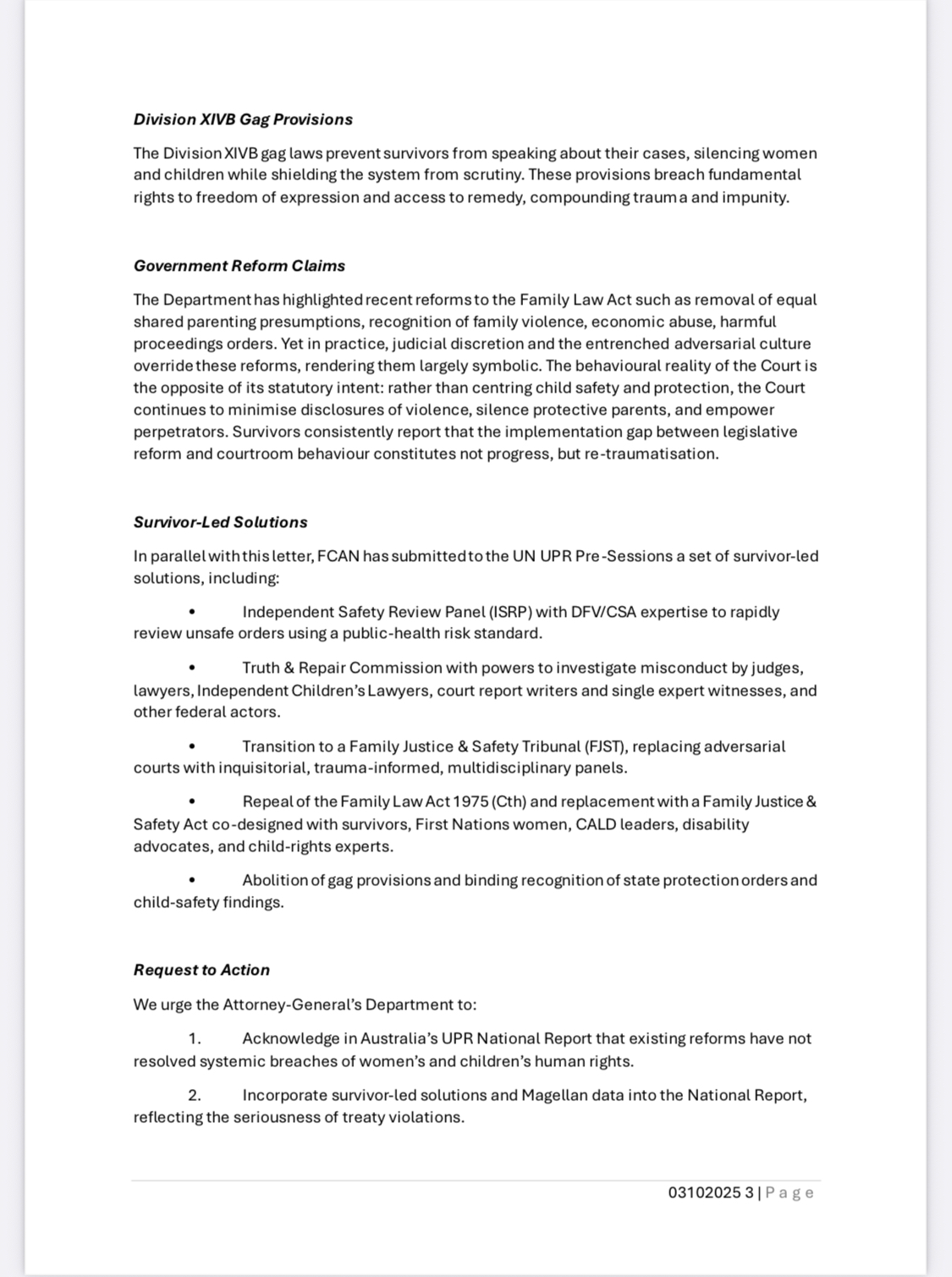
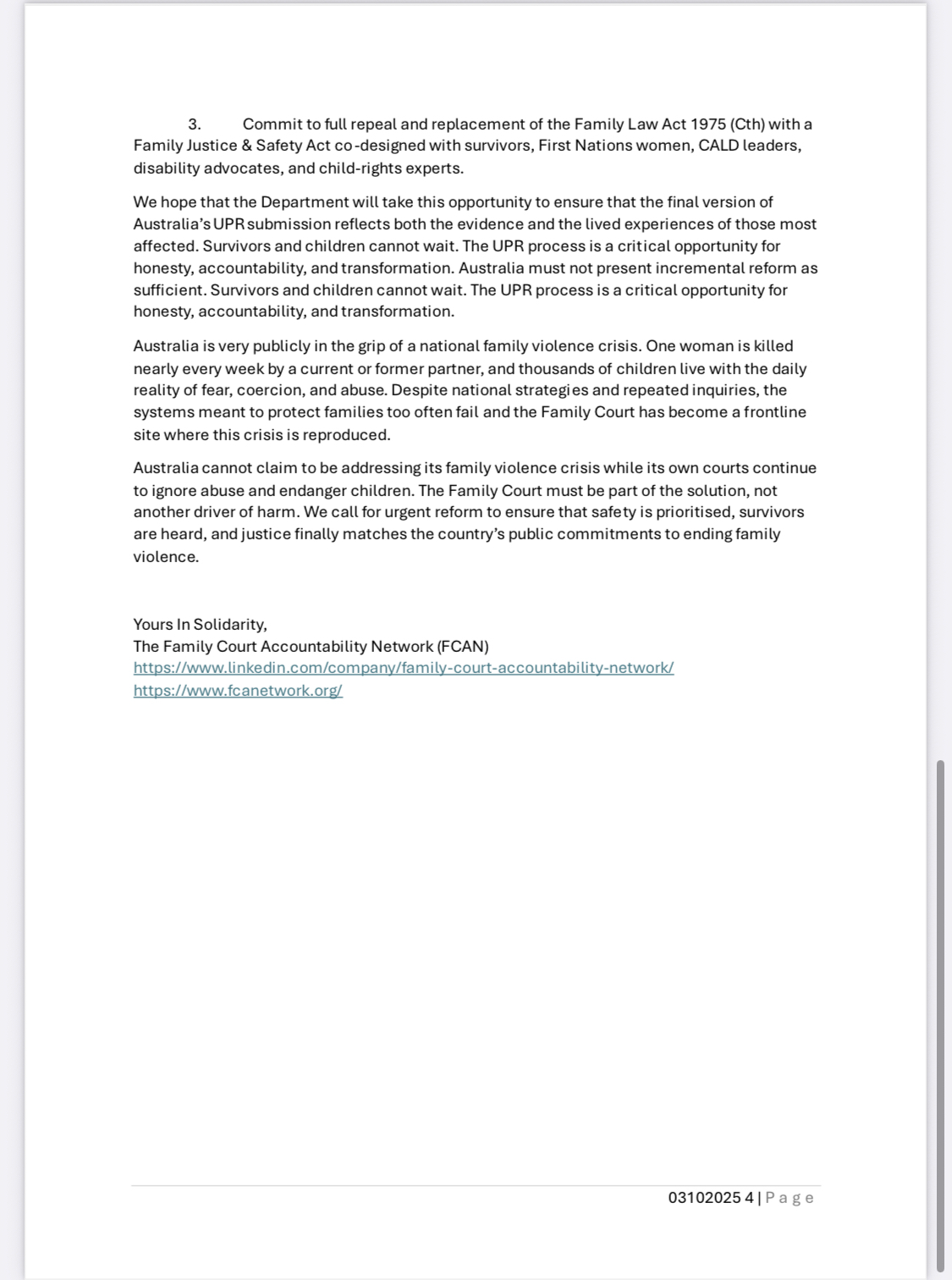
In October 2025, we submitted our letter to the Attorney-General requesting that the Magellan findings and survivor-led solutions be incorporated into Australia’s final National Report. The response was yet another standardised brush-off, another addition to the ever-growing “nothing to see here” file survivors know too well.
But this submission stands. It documents what Australia refused to include. It makes visible what our courts continue to hide.
Writing it was retraumatising, heavy, and often overwhelming, but necessary. FCAN exists because the women and children failed by this system deserve truth, accountability, and change, and because survivors should never again be erased from Australia’s human-rights reporting.